
ICG is moving fast. The next step is intelligence.
More companies are making ICG now, because fluorescence-guided surgery has caught on. We build the layer that analyses the signal, whoever makes the dye.
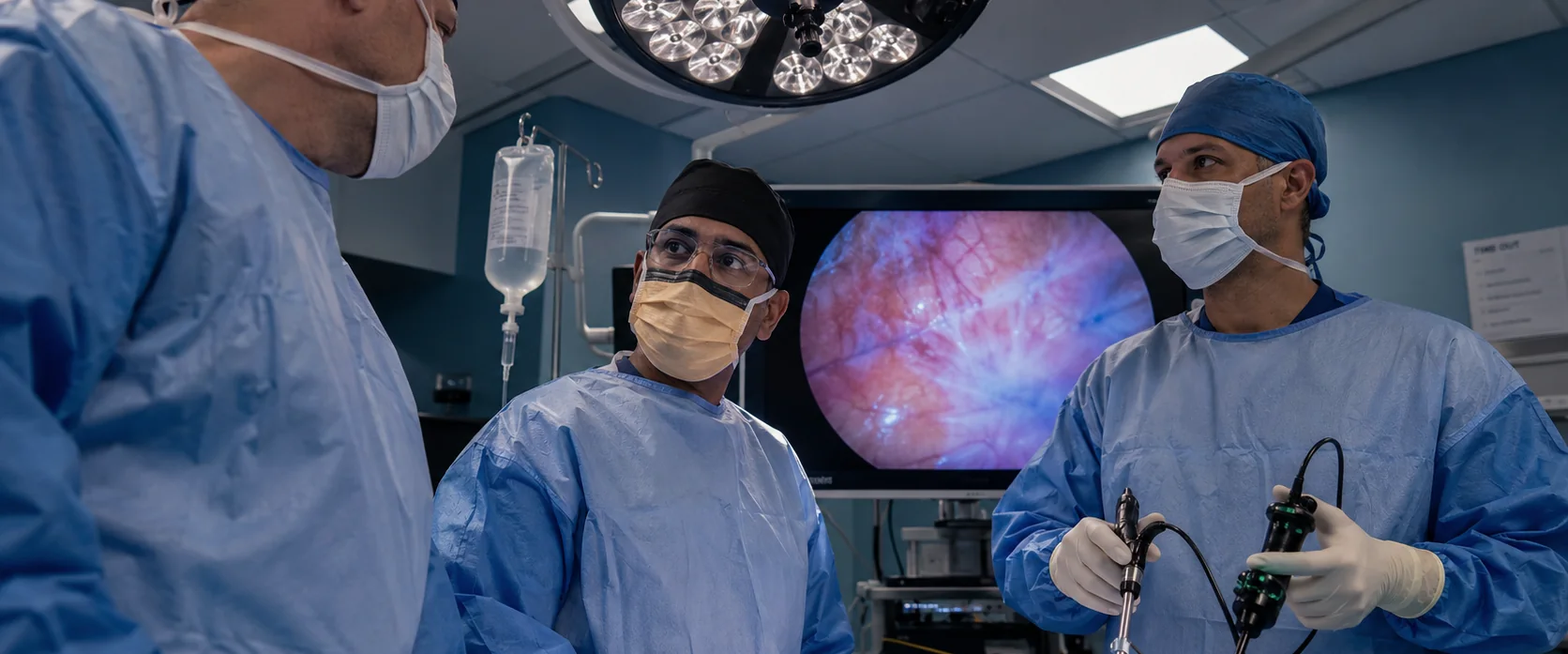
In September 2024, American gynaecological surgeons were told to make the dye last. Save it for early disease. Share vials with urology, colorectal and plastics. Book cases back to back, because once it's mixed it's only good for six hours. And halve the dose, from about 4 mL down to about 2.6
The dye was indocyanine green. The reason for the advice was that the United States had one approved supplier, and it had run short.
That changed this summer.
-
10 Jul 2026
The FDA approved ZYOGREEN from Provepharm: indocyanine green as a ready-made solution, 25 mg in 10 mL, in glass ampoules. No mixing needed.1
-
4 Aug 2026
The FDA gave Zydus Lifesciences final approval for a generic version of IC-GREEN, 25 mg per vial, with a Competitive Generic Therapy designation.2
A sixty-seven-year-old dye finds new use
ICG is not new. IC-GREEN was cleared for use in February 1959, and for most of the years since it did quiet work: measuring cardiac output, photographing the back of the eye.5
Then surgeons found it. Inject ICG, shine near-infrared light on the tissue, and blood vessels and blood flow glow on the screen. It turns out that is useful in a great many operations, and word got round. US sales of IC-GREEN grew around 60% in the year to June 2026.2
Rising demand, one supplier and a shortage. The FDA has a designation for exactly that, and it gave one to Zydus. It is reserved for drugs with no more than one approved version on the market.3 The FDA notice that made a generic possible had been published in November 2024.4
The cameras became common equipment
While the dye was in short supply, the hardware quietly became universal. Fluorescence imaging used to be something you paid extra for. Intuitive's 2025 annual report now calls Firefly, its near-infrared imaging, “a standard feature of the da Vinci 5, da Vinci X, da Vinci Xi, and da Vinci SP surgical systems”.7 Every current da Vinci comes with it fitted.
The laparoscopic towers went the same way. And ICG is no longer the only dye on the shelf: Gleolan, Cytalux and Lumisight are all approved for use in surgery now.8
The dye is getting cheaper. The cameras are everywhere. What's left is extracting the knowledge from the images.
One look, and then the dye washes out
A surgeon gets a single pass at it. The camera makes a picture, the surgeon reads it in the middle of an operation, and then the dye washes out and the moment has gone.
But the picture is never still. The dye arrives, fills the vessels, spreads into the tissue and drains away, and it does all of that at different speeds in different places. An artery fills before a vein, and empties before one too. Watch the whole sequence and the anatomy sorts itself out.
Two structures, one injection
How the dye arrives and leaves in two structures in the same view. The axes have no units. Sketches, not measurements.
The research says the same thing. A study in Frontiers in Surgery this June ran 80 of the same operating-room recordings through two ICG analysis programs. The timing measurements agreed almost perfectly. The brightness ones didn't. And given identical video, the two programs still came out with different numbers.9 Nobody has settled how to read this signal yet.
What we're building
Navisurg Vision builds the software that reads fluorescence. We don't make dye and we don't make cameras. We work on what happens in between, and we'll work with whoever supplies either end.
Our software watches the whole video rather than one frame at a time. It separates vessels from lung, keeps track of them as the patient breathes and the camera moves, and tells arteries from veins by when they fill and when they empty.
We're starting with keyhole lung surgery. In a segmentectomy the surgeon has to find small arteries, small veins and the line between well-supplied and poorly-supplied lung, all through a camera. It's a hard case, which is why we picked it.
It works with the camera already in the room. It runs on the machine, not in the cloud. It adds nothing to the sterile field. And the surgeon still decides.
We build the intelligence layer, whoever makes the dye.
- ZYOGREEN (indocyanine green) injection, prescribing information. NDA 218579, Provepharm Sas; approved 10 July 2026. DailyMed
- Zydus Lifesciences, “Zydus announces final approval from the USFDA for Indocyanine Green for Injection”, 4–5 August 2026. The IQVIA figures for the year to June 2026 are quoted in that announcement. Business Standard
- US Food and Drug Administration, Competitive Generic Therapies: Guidance for Industry. Section 506H of the FD&C Act defines “inadequate generic competition” as not more than one approved drug in the active section of the Orange Book. fda.gov
- “Determination That IC-GREEN (Indocyanine Green), 25 Milligrams/Vial, Was Not Withdrawn From Sale for Reasons of Safety or Effectiveness”, Federal Register, 20 November 2024. federalregister.gov
- “Determination That IC-GREEN (Indocyanine Green for Injection), 10 Milligrams/Vial, 40 Milligrams/Vial, and 50 Milligrams/Vial Were Not Withdrawn From Sale…”, Federal Register, 13 December 2018. This is where the February 1959 date and the 1989 approval of NDA 011525 are recorded. federalregister.gov
- Society of Gynecologic Oncology, Clinical Practice Advisory: Indocyanine Green (ICG) Dye National Shortage, 20 September 2024. sgo.org
- Intuitive Surgical, Inc., Annual Report on Form 10-K for the year ended 31 December 2025, for the Firefly quotation; and the fourth quarter and full year 2025 results of 14 and 22 January 2026 for the installed base, procedure numbers and system placements. SEC EDGAR
- Fluorescent agents approved for use during surgery besides ICG: 5-aminolevulinic acid (Gleolan), pafolacianine (Cytalux) and pegulicianine (Lumisight, April 2024). PMC11981469
- “Cross-software comparison shows strong agreement for quantitative indocyanine green fluorescence angiography in reconstructive surgery”, Frontiers in Surgery, 24 June 2026. Time-to-peak agreed across platforms at ICC 0.979; the normalised maximum-slope measures agreed at 0.412 (inflow) and 0.315 (outflow). frontiersin.org